
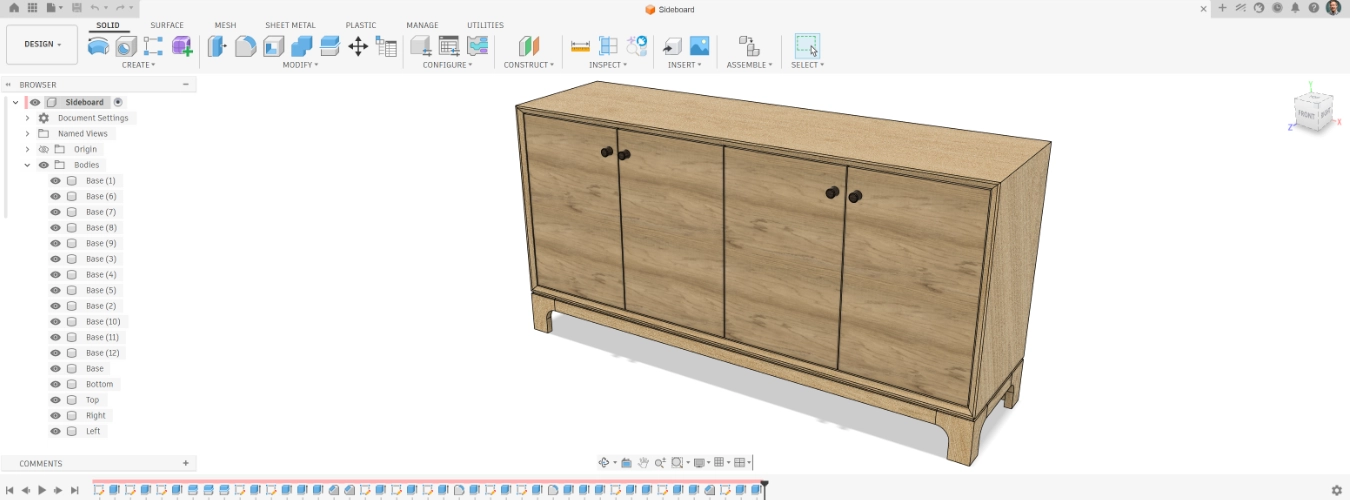
Let’s acknowledge, that there is a LOT of CAD packages out there. But what is the best? Without beating about the bush, my opinion (as of Aug 2026) is that Autodesk Fusion 360 is your best package! But, there are plenty of other packages and it’s worth doing your research as another platform my suit your needs better.
Why? It’s cheap (sometimes free), easy to use, great visuals, well featured and plenty of scope to migrate into more ‘professional’ software in the future if you need to.
Who am I to give you an opinion? I have worked as a Design Engineer using CAD packages extensively since 2006. For many years, I used and championed Solidworks as the best package. I am even Professionally certified to use Solidworks. Though now I have migrated entirely to Fusion 360 for a whole host of reasons.
Do woodworkers need CAD? No, they don’t. But do engineers need calculators or scientists need lab coats? We all love tools, and CAD is just another tool that allows us to do what we do, just a little better. Much better to make a mistake on the computer and quickly fix it there, rather than in the workshop after hours of hard work.
I have now retired from my role as a Product Design Engineer to become a full-time Woodworker who designs and engineers his own furniture (actually, I suppose it’s not all that different). Coming from a CAD world, I naturally continued to use CAD software because I find it an extremely useful design tool.
In CAD, I can rough out a design quickly. Then after fine tuning the aesthetics, I can begin to work out how to make it. Most CAD software has an intelligent ‘history’ that can be rewound at any point and altered. If for instance, I designed a sideboard, then decided I wanted it a little longer, I would simply rewind, add the extra length, then fast forward again. Boom, I have a sideboard with the updated dimensions! Really useful if you change your mind, but equally useful if you need to make multiples that are all slightly different dimensions.
So no, woodworkers don’t need CAD. But, if you are a modern woodworker, looking to use the best tools to do a better job, faster. Then Yes, you should get some CAD software.
Comparing CAD Packages. Let’s start by saying, these are all good packages that each have a place. This advice is based on woodworking and the specific requirements that we have.

My recommendation for woodworkers is Fusion 360. It’s a strong, well‑rounded option that will comfortably meet the needs of most makers. Developed by Autodesk, it’s essentially the leaner sibling of their full‑blown CAD package, Inventor. In this case, being the “little brother” is an advantage: it’s far more affordable (often free for solo makers) and significantly easier to learn. Yet it still offers all the core features required for woodworking, 3D printing, and CNC work.
I’ve used Fusion for over eight years—first in engineering, now in woodworking—and it has consistently proven capable. It can model virtually any shape, integrates smoothly with manufacturing workflows, and remains reliable and approachable. In many ways, it delivers the functionality of the big players at a fraction of the cost.
That said, Fusion does have a few shortcomings, and I’m disappointed that Autodesk hasn’t addressed them. Development seems to have slowed, perhaps intentionally, to preserve the gap between Fusion and Inventor. Because of this, if you’re a larger company with the budget, SolidWorks is still the better choice. For everyone else, Fusion remains the best value—provided we keep hoping Autodesk eventually tackles these lingering issues.
Here are the main frustrations:
Model robustness Fusion’s parametric engine is less stable than other platforms. Even small changes—like adjusting a sketch dimension—can trigger errors instead of simply updating the model. This kind of parametric reliability is fundamental, and Fusion really should be stronger here.
No true configurations Proper configuration support would be a game changer. SolidWorks allows multiple variations of a design within a single model, with only a few dimensions changed. For woodworking, where you often need several versions of the same piece, this would be incredibly valuable.
General usability quirks This is harder to quantify, but Fusion often feels like it takes four steps to do something SolidWorks can do in two. Simple quality‑of‑life features—navigating with arrow keys, tabbing through menu options, or having sketch extrusions automatically select the sketch rather than nearby faces—would make a big difference. More recently, bodies blocking dimension edits in sketches has become a constant irritation, forcing you to toggle visibility on and off. None of this is catastrophic, but these are problems other CAD packages solved decades ago, and fixing them would dramatically improve the experience.
Despite these weaknesses, Fusion 360 is still easy to recommend when you look at the whole picture. It’s currently free for makers below a certain income threshold and reasonably priced beyond that. For most woodworkers, it remains the best balance of capability, cost, and accessibility.

This software is relatively new to the scene, which I personally see as a positive. The software needs to perform to attract customers, rather relying on legacy. It looks to be a great bit of software which runs natively on your devices (a good thing). I haven’t used it personally, but it looks to be fully featured and well thought through professional CAD package. It’s nice to see a CAD package that can output high quality renders, without having to purchase secondary add-ons.
The software is free for your first two models, so worth testing. Then goes onto a subscription model costing about £21 per month. This isn’t cheap, but it’s a whole lot less than the established players on the market. This is one to keep an eye on for the future.

Again, this software is relatively new to the scene, and again one that I have no personal experience with. It does however appear to be a full featured, professional CAD package that has already been adopted by many large professional companies and solo makers.
It appears to be in competition with the big boys of Solidworks and Inventor, but with a much more attractive price tag. As a startup professional company, this could be a very attractive option and certainly something I will consider as the company grows. It does seem to have several of the professional features that I miss when using Fusion360.
Its pricing structure is free for individuals (which is great), but all your files will be public. This means this package isn’t suitable for any work where you want to keep the build files private. The next package is $1500 per year for private storage or £2500 per year if you want simulation and rendering. It always frustrates me when companies put the rendering feature in the highest price point, but unfortunately, they all seem to do it.
Given you can start using this package for free, then it is certainly worth a look if you don’t mind you files being public, or just want to test it out before you commit.

I have very little experience with this package as it has never been well featured enough for my needs. As a woodworker however, I think it could be a very desirable package. If you look carefully there is a free version, although I do find it very confusing the pricing structure and what is available at each price point. It seems to have a nice interface and only contains the functions that we need.

Inventor is the big brother of Fusion 360. It looks similar but works quite differently. This is a professional CAD package that is highly featured and able to cope with much more complex designs. It addresses all my criticisms of Fusion but comes with one major disadvantage… the price! This package is intended to compete with the likes of Solidworks. I have little hands-on experience with the software, but I would say it is as good as Solidworks. But, because it is used less in industry, it can be harder to collaborate with.
The price is around £2,500 per year, which makes it more expensive than Solidwork’s basic package, but cheaper than their middle and top-end package.

My experience with SolidWorks goes back more than a decade. I used it extensively until around 2018, when I eventually moved over to Fusion 360. For many years I was a strong advocate of SolidWorks, but toward the end of my time with it I became increasingly frustrated by the slow pace of development and the steadily rising cost—especially for small makers. I wanted more capability, yet features seemed to be moving behind additional paywalls rather than improving the core product.
Even so, SolidWorks remains an excellent CAD package: versatile, feature‑rich, robust, and deeply embedded across industry. The advantages of using a mature, widely adopted platform are significant, and if you rely on CAD heavily enough to justify the cost, it may still be the right choice. Despite its drawbacks, I often miss using it.
Pricing (confirmed current as of 2026)
SolidWorks does not publish official list prices, but multiple independent sources provide consistent ranges:
Commercial subscription pricing: $2,820–$4,716 per year, depending on whether you choose Standard, Professional, or Premium. (This aligns closely with your original figure of ~$2,800 for the base tier.)
SolidWorks for Makers: $48 per year, available to hobbyists earning under $2,000 annually from their projects.
These prices are consistent across multiple sources, though actual quotes can vary slightly depending on reseller, region, and whether you choose subscription or perpetual licensing.
My take
I would genuinely love to use SolidWorks again, but the jump from $48/year to $2,820+/year is simply too steep for small makers who exceed the $2,000 income limit. That gap makes the Makers license inaccessible for many of us, and the commercial pricing hard to justify unless CAD is a central part of your business.

I have a love/hate relationship with this software and have used it many times throughout my career. It has the beauty of working just like a manual drawing board. To get the most from the software, you really need to know how to use a drawing board and all the tricks. This can be tedious, but also rewarding.
The truth is, however, that it is rarely, if ever the best option for engineers, designers, or woodworkers. There are simply far better options! Instead, this software is more of a legacy software from the ‘olden’ days.
I would NOT recommend this software, particularly if you want to work in 3D.
Honourable Mentions
Here is a list of CAD packages, that deserve a mention, though I have little experience with. As such I am not well placed to pass judgement on their appropriateness for woodworking.
SketchList 3D – a CAD package design specifically for woodworking. Simple package, one-click joints, different wood types and easy to make drawings. Could be a strong contender if you are making standard woodworking furniture. Though limited if you want to do much else.
Pro100 – listed as woodworking software, though from what I gather is potentially more suited to interior designers and kitchen planners. If this is what you are doing, it’s worth a look.
Rhino 3D – this is a surface modelling software which is probably not well suited to woodworking applications. Having said that, it is extremely powerful and capable software that might be worth a look for those niche applications.
Blender 3D – this is an extremely powerful 3D rendering package that is completely free. It could in theory be used for woodworking, but it is far better suited to 3D animation than woodworking. What it would be well suited for, is rendering your model (produced in Fusion) into a photorealistic image.
Keyshot – not a CAD package, but a quick and easy way to get photorealistic images from your CAD models. Unfortunately the price of this platform has gone through the roof in recent times, but if ever they have a sale it might be worth a look.
